I Asked Four AI Engines to Recommend Hotels. Half of Them Did Not Exist.
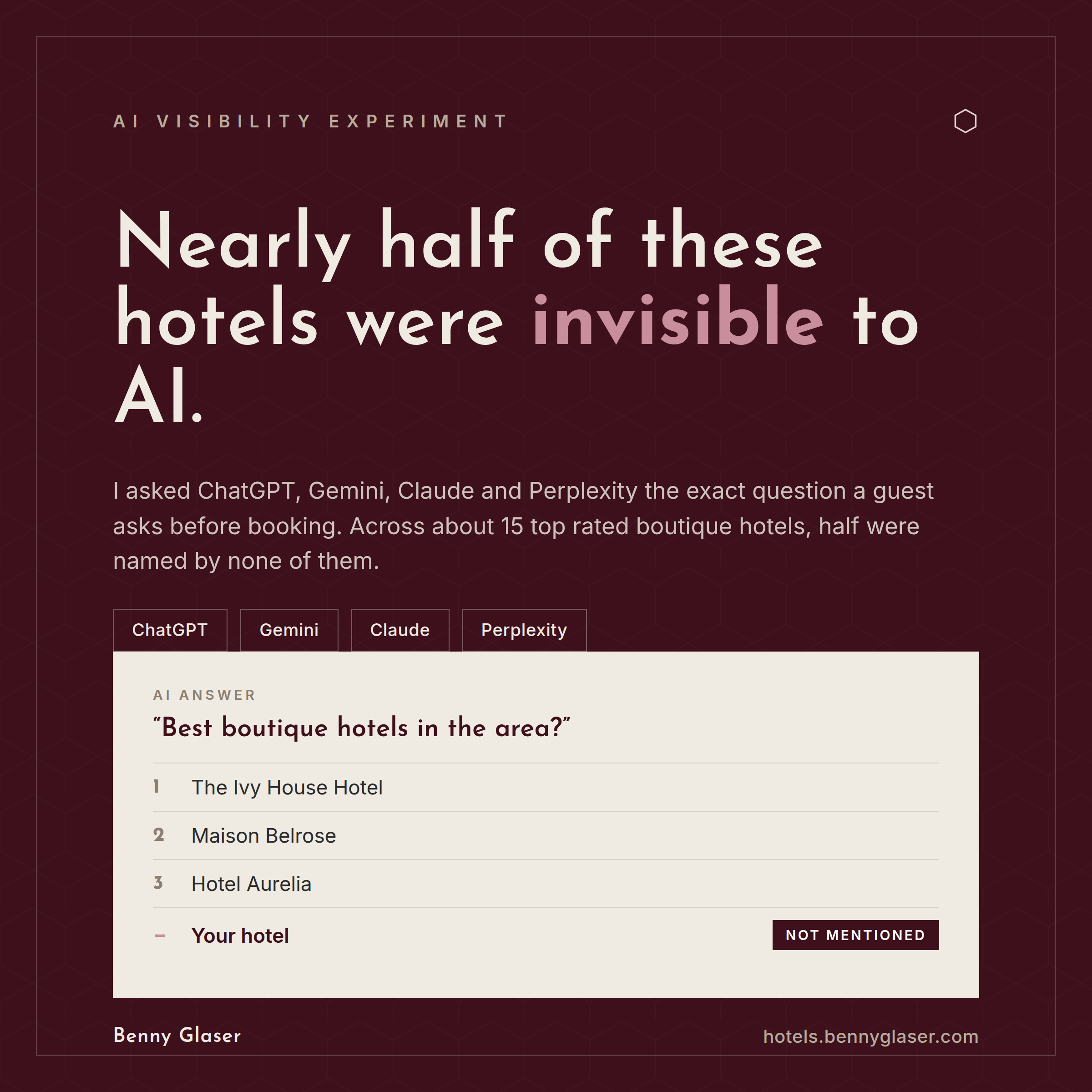
I ran a quiet experiment this week, and the result has stayed with me since. I took about 15 boutique and spa hotels across the Alps and the coast of Portugal. These were not struggling properties. They were rated 4.5 and higher on Google, with hundreds of glowing reviews, beautiful websites, and the kind of quiet luxury that fills rooms in high season. Then I did something their guests are now doing every day. I opened the four big AI engines, ChatGPT, Gemini, Claude and Perplexity, and I asked each one the same simple question: What are the best boutique hotels in this town? Then I read the answers and checked one thing. Who got named, and who did not. Nearly half were invisible Almost half of these hotels were not mentioned by a single one of the four engines. Not once. A traveler sitting on their sofa, asking AI where to stay, would never hear their name. The hotel is simply not in the conversation. And to be clear, these were not obscure guesthouses. One of the invisible ones has a 4.6 star rating and almost 1,000 Google reviews. Another sits at 4.6 with more than 400 reviews. On every metric a hotelier has been told to care about, they are winning. To the AI, they do not exist. Meanwhile, in every single town, the same two or three hotels showed up on almost every list. Not always the highest rated ones. Just the names the models had learned to trust and repeat. There is now a small club of hotels in each destination that AI recommends by reflex, and everyone else is competing for a seat that has already been taken. Three things that surprised me The headline is dramatic enough, but the details are where it gets useful. Your Google stars do not decide this. Some of the best reviewed hotels in my little sample were the most invisible. A wall of five star reviews is wonderful for the guests who already found you. It does very little to make an AI mention you to the guests who have not. These are two different systems, and most owners assume the first one feeds the second. It does not. It is unstable. I asked about one hotel on two different days and got two different answers. Recommended once, ignored the next. If your visibility can flip between a Tuesday and a Thursday, you cannot afford to check it once and forget it. The owner, of course, has no idea any of this is happening at all. The technical layer matters more than people think. Several of these highly rated hotels scored near the floor on a simple test of how well an AI can actually read and understand their website. Slow pages, content buried inside scripts and images, information a machine cannot easily parse. If an AI cannot read you, it cannot recommend you, no matter how lovely the place is in person. This is not really about hotels I used hotels because they are a clean test. A guest asks a clear question, the answer is a short list, and it is easy to see who made the cut. But nothing about this pattern is specific to hospitality. Think about how you make a decision now. When you need an accountant in your city, a clinic that treats a specific condition, a law firm for a particular case, a software tool for a niche job, more and more of us do not open ten blue links and scroll. We ask. We ask ChatGPT or Gemini or Perplexity, we read the three names it gives us, and we start there. The AI answer has quietly become the new front page, and a front page only has room for a few names. So the real question is not whether hotels have this problem. It is this: when someone asks AI for exactly what you sell, are you in the answer, or are you the one who does not exist. For most businesses, nobody has ever checked. That is the whole opportunity, and it is closing. Why some businesses get named and others vanish AI models do not have opinions about your business. They assemble an answer from what they can find and read about you, and a few patterns decide whether you make the list. The first is whether a machine can actually read you. Clean, fast pages, real text rather than words trapped in images, and clear structured information about who you are, where you are, and what you do. This is the part most sites quietly fail. The second is whether anyone else talks about you. Models lean heavily on third party sources. Directories, reputable roundups, review sites, local press, industry associations, and in the case of hotels, tourism boards and booking platforms. If your name appears in those places, described consistently, the model learns to trust it. If your entire online presence is your own website, you are asking the AI to take your word for it, and it usually will not. The third is consistency. The same name, the same details, the same description of what you do, everywhere. Contradictions make a model hedge, and hedging means it reaches for the safer, more established name instead of yours. None of this is mysterious, and none of it requires you to game anything. It is closer to good hygiene than to a trick. But it is invisible work, so almost nobody does it, which is exactly why the few who do end up owning the answer. What I would actually do about it If you run a business that people ask AI to recommend, and today that is most businesses, here is the honest short list. Start by finding out where you stand. Ask the four engines the questions your customers would ask, in your own city and category, and write down who gets named. It is sobering, and it takes ten minutes. Then make sure a machine can read your site. Fast mobile pages, real text, and clear structured data describing your business. Get yourself described accurately in the places AI trusts, not just on your own homepage. Keep your name and details consistent everywhere they appear. And check again in a month, because as I learned, this moves. That is most of the work. It is not glamorous, but the hotels that get named are not doing anything magical. They are simply legible to the machines that now make the recommendation. Where to start This is exactly what I built for hotels. At hotels.bennyglaser.com you can run your full AI Visibility Report across all four engines. It shows you precisely where you stand, which competitors the AI names instead of you, and the specific actions that will move you into the answer. You see the result on screen straight away, and reports start at $69. And if you are not in hotels but that question just made you a little uneasy about your own business, that is the right instinct. The engines are already answering. The only choice you have is whether your name is in the answer. If you want help finding out, you know where to reach me. (No hotels are named in this post on purpose. This is about the pattern, not about calling anyone out.)